
Social Enterprise orSocial Enterprise, a terminology that has begun to be heard a lot among entrepreneurs and activists in Indonesia recently. What is done by Social Enterprises is believed to be able to answer various problems that exist in our country, but is it true? Let's explore further.
To date, there is no standard definition of social enterprise. These two words are often read contradictory:
Business based onKBBI means: (1) activities by exerting energy, thought, or body to achieve a purpose; profession (deeds, initiative, effort, effort) to achieve something; (2) activities in the field of trade (with the intention of making a profit); trading; company.
Social based onKBBI means: (1) with respect to society; (2) likes to pay attention to the public interest (like to help, donate, etc).
How can a company that carries out profit-making activities but also helps or donates for the public interest??
Social Enterprises keep trying like a profit-seeking company, however most of the profits are reinvested to meet social and/or environmental goals. Because of this goal, social and/or environmental impacts are often placed above considerationfinancial alone. Thus, Social Enterprises must be understood as a movement that changes the mindset of individuals who want social and/or environmental change and run a sustainable business simultaneously..
Social Enterprises has only recently become popular in Indonesia, but the approach used by Social Enterprises is not new in the world.
This terminology began to be known when many organizationsnon-profit start using business strengths and approaches to bring about social and/or environmental change from its activities. In England, Social Enterprisebecame known in the middle of the year1900an, and at that time many companies began to use 'labels'Social Enterprisebut actually they are notSocial Enterprise.
Currently in United States, Social Enterprisecan be categorized as a sector that is growing rapidly as evidenced by the increasingimpact investing"from the investors and"conscious consumerism"from the consumer's side". This increase was not present immediately, because it takes many parties who hold tightly to supportSocial Enterprise, such as academics, namely Harvard Business School who foundedSocial Enterprise Initiative in year 1993 as well as the government withSocial Innovation Fund which was initiated in 2009.
To avoid conventional businesses that-hijack Social Enterprise terminology in the UK, then formed 6 characteristicsSocial Enterprise:
- has a social and/or environmental mission in its legal documents
- The majority of their income comes from buying and selling (commercial)
- reinvest the majority of the profits
- autonomous and independent
- majority controlled by the interests of the social mission
- responsible and transparent
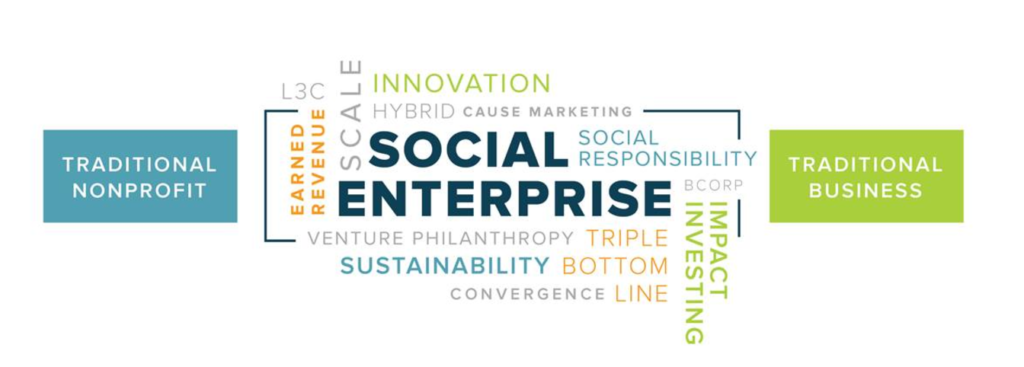
Social Enterprises vs Conventional Enterprises
The thing that most distinguishes Social Enterprises from conventional businesses is the treatment ofprofit/profit from his business, where Social Enterprises work to make significant change, reinvest most of their profits (more than 50%) to carry out their social and/or environmental goals.
On the sidejobs, Often Social Business actors also provide jobs to those who are left behind (either because of competence or because of where they live), those who actively participate in preserving the environment, and provide services to those who are also marginalized.
Social Enterprises mustowned and controlled based on the interests of social and/or environmental goals. If a Social Business is in the form of a Limited Liability Company, Ownership means ownership of shares of the company. The majority ownership of Social Enterprises must be for social and/or environmental interests, which in the sense that shares can be structured with different types and classifications of shares to parties who ensure that these interests are fulfilled.
What's more, it must be ensured that every asset of the Social Enterprise is protected for social and/or environmental benefits. This term is commonly called asset lock, so that there is certainty that there will be no transfer of property ownership outside the interests of the purpose of Social Enterprises. This will be discussed in more detail in the next article.

CompanyEthical vs Social Enterprise
Not all companies that already exist and have a social impact on the community are members of the Social Enterprises group. Such as companies engaged in and/or related to natural resources by carrying out social and environmental responsibilities (Corporate Social Responsibility). This is an obligation from the government to be carried out by the company, which if the company follows its obligations, it will avoid legal entanglement and may be categorized as a companyEtichal.
Company CriteriaEtichal very different and the aim of a company like this in the field of natural resources is to minimize the negative impact on the social and natural environment as a result of their operational activities..
Companies like this are not the same as Social Enterprises, which is essentially formed to provide benefits to the community and the surrounding natural environment without any coercion or obligation from the government but on its own initiative.

Source of funds
In conventional business, we can divide the source of funds into two instruments: equityordebt.Especially for Social Enterprises, apart from these two sources, can receive other sources of funds, namely:grant(grant) and donation.
Equity participation(capital participation) can be obtained from investors, good from friends, family, angel investor, orventure capital.Because Social Enterprises reinvest most of their profits in social and/or environmental missions, then searchinvestornot necessarily the same as conventional business. Social Entrepreneurs must seekinvestorwho understands the risks of investing in Social Enterprises, andinvestor Those who are looking for Social Enterprises are often referred to asImpact Investor.
Debt (debt)can be obtained from financial institutions such as banks, micro-lending, and similar financial institutions. Even, now availablemicro lending platform which focus on certain business sectors such asKiva in America andVasham in Indonesia. The thing to note from this source is that the requirements are not the same between banks and other financial institutions, You need to carefully pay attention to these requirements so that the submission of funds is not hampered.
Third, Grant, which can be in the form of a grant, donations, sponsorship, and other forms that are not binding likeequityordebt. The source of these funds is usually used by foundations, community, ornon-profit organization, however, due to the social and/or environmental mission in Social Enterprises, therefore grants can be a source of their funds. The parameters of the grant are usually measured based on the completion of a project. Grants can be searched in various international organizations, such as USAID, ausaid, YSEALI, and others.
Whatever the source of funds, Every Social Enterprise actor needs to remember that the last source, grant, cannot be the main foothold of the Social Enterprise funding source. This is because in essence Social Enterprises continue to carry out commercial activities to support their business operations, andgrantis the main source of fundsnon-profit organization, not a social enterprise.
Public Service Problem Solution
Activities carried out by Social Enterprises are not only tied to conventional business activities. But, they also do activities that should beobligation to government like public service.
As mentioned by Peter Holbrook, Chief Executive dariSocial Enterprise UK: “The old ways of getting things done-public services versus charities, versus private enterprise- are starting to merge and the future is hybrid.”
The need for good public services and the desire to change without being dependent on complicated bureaucracy and unnecessary fundssustainfrom donations make Social Business actors try to break down and provide concrete solutions.
In year 2013, William Eggers & Paul Macmillan wrote a book entitled “The Solution Revolution”, which basically discusses how business people, government and social business actors collaborate to answer very difficult problems in society. By removing the wall betweenpublic-private sector, a solutions-based economy can unlock new business models that have social impact as well as commercial value.
Various services that should be guaranteed by the government, among others, are: affordable medical services, use renewable energy, and fight poverty. These things should be the responsibility of the government but become opportunities for Social Enterprises to answer these challenges. What's more, they are here to answer the most difficult problems: against malaria, provide affordable housing and education to the poor.
Another concrete example is answering the problem of clean water. Imagine, 1:10 people in the world or 663 million people live without clean water. The need for clean water is not just for thirst, but also for sanitation. Realizing this, Various Social Enterprises have emerged that answer this problem, for exampleJerry Bottles who sellsreusable water bottles. as big as 100% Profits from the sale are donated to clean water projects around the world.
In the so -called marketSolution Marketthis, whole Social Enterprise, Non-Profit Organization, Multinational companies compete, coordinate and collaborate to answerMegaproblems. Foundation, corporate philanthropy, government and often business people, act as funder, investors and market makers (market makers).
What sets it apart from collaboration inSolution Marketthis is unlike government -driven programs that are limited to political territory, solutions like this spread all over the world. This is proof that solution-based business activities can be carried out by Social Business actors in collaboration with various companiesstakeholder to answer public problems. This is discussed more deeply in the bookEggers & William the.
Starting a Social Enterprise
To start running a Social Enterprise, you can start to get to know the community in various locations, for example in coworking spaces like Coworkinc and now. What's more, The Social Enterprise movement has now begun to bloom with the presence of Social Business Platform and various business incubator programs such as READY and UnLtd.
(https://medium.com/@ivanlalamentik )